The Abject Horror of the Unfiltered Internet in 2025
Posted on: 23 October 2025
The Internet Archive recently celerbated its 25th Birthday, which is amazing for them as an organization in the light of... well, everything, but mostly I find it impressive given how often it's overlooked by the average internet user just how much webpages decay and how much the Internet Archive does to preserve our rotting ocean. I've been a supporter of the Internet Archive for awhile, which is why I was so shocked when I realized that the Internet Archive does not preserve advertisements. This isn't a bad thing, web advertisements are a raw cosmic nightmare gnawing away at the feathering edges of sanity that we wrap ourselves in, but it does mean that in the future, if the Internet Archive is still around, it will not serve as a good representation of the horrors that that raw unblocked internet beams straight into our corneas. Lo, though we subject ourselves to the temptations of the digital sea, we have learned to unsee the worst parts of it. As an experiment, I'm going to walk through the process of opening and reading a few webpages to document some of the horrors.
I will be performing this labor from the perspective of an arbitrary new machine and a VPN'd location to try and prevent as much of the constant spyware-level tracking that advertisers use to stab at our attention. For maximal cleanliness I could boot a fresh VM and run everything through that, but for ease of blogging and to retain the scrap of joy that I would lose by booting a Windows VM I'm instead using Windows 10's pre-installed bloatware, Edge, after scrubbing it of cookies. I'll be VPNing through Seattle, because I want to.
YOUR LOCAL NEWS HERE
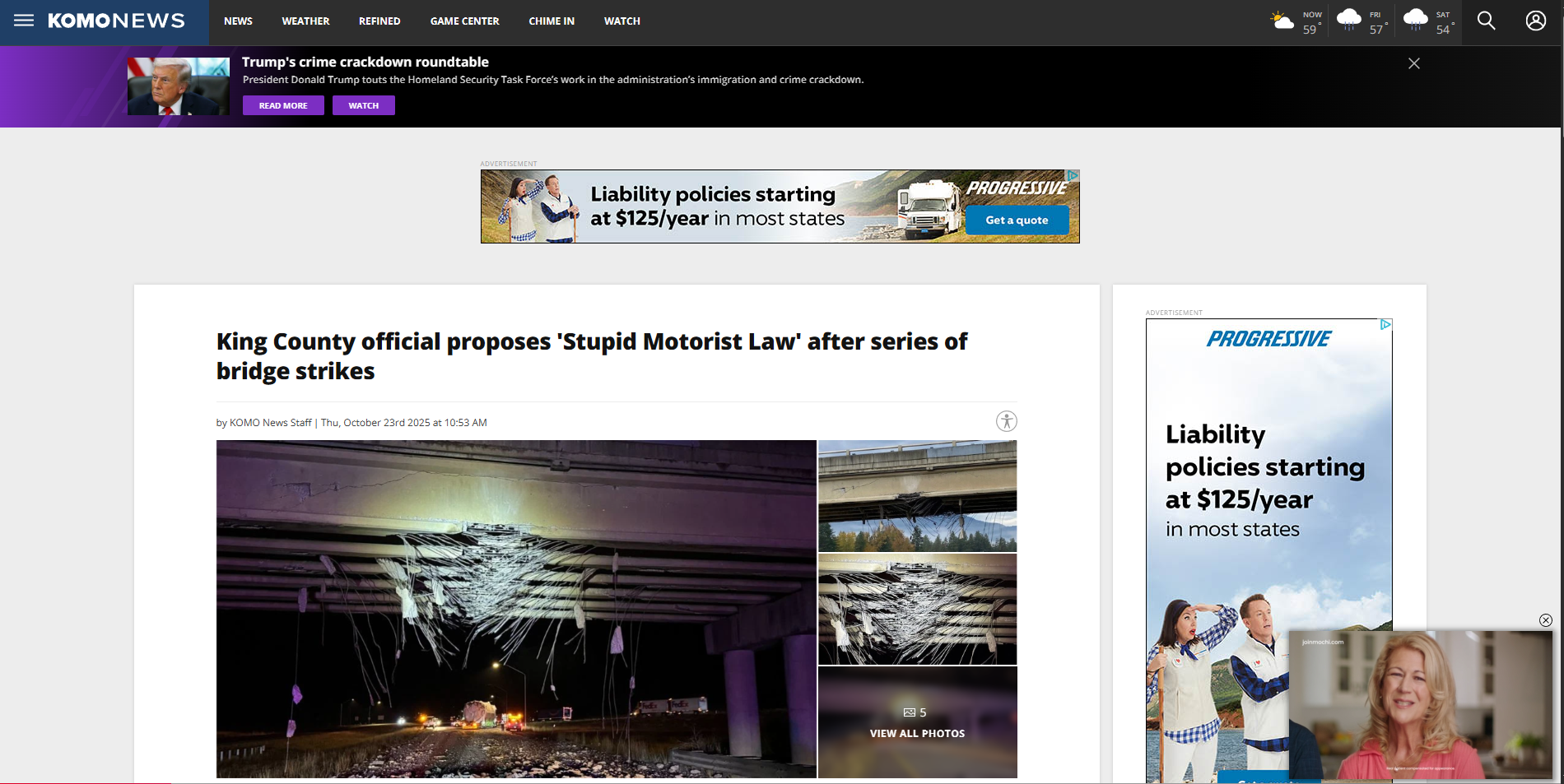
This is KOMO news, like most news stations in America it has a nonsense four letter abbreviation due to FCC registration regulations. KOMO, as with most American local news, is owned by the Sinclair Broadcast Group. It may or may not be relevant later, but Sinclair is well known for pushing "must run" segments to local news stations across the nation where they promote the conservative policies and ideas that large corporations necessitate to continue existing. If YouTube, a video sharing service run by a similarly troubled massive corporation, still exists in the future then you can watch popular comedy toucan and former Community college professor John Oliver's segment on Sinclair.
Upon selecting an article at random, there are three obvious advertisements on the screen with a fourth probable advertisement lurking. Two of these advertisements are the relatively benign Google adsense ads that cycle constantly through a mystery selection of advertisements with some targeted to specific types of users and others just blasted out at random as general advertisements by uncaring corpo-monoliths. The two that are most prominent are ads for Progressive, a car insurance company. In 2025 America, car insurance is a required expense for automobile owners. Differing companies offer different rates of insurance with different features and prices that vary wildly based upon the purchaser's age, accident history, the type of automobile, and other factors. As an advertiser, Progressive was an early adopter of the "funny" advertisement style that would eventually mutate into Wendy's social media interns making jokes on Twitter.
In the bottom right corner of the page is a video advertisement that began autoplaying once loading into the webpage. This is not just an adsense video, but instead it comes from a corporation called Primis (not to be confused with the at least eleven other companies named Primis that I found with twenty seconds of searching) which specializes in injecting adsense ads into videos like a parasitic wasp. Once the ad finishes playing, the video swaps to a clip from KOMO news. Blessedly for all of us, the volume on the advertisement player is disabled by default.
The fourth ad, lurking, is the one at the top and labeled "Trump's crime crackdown roundtable". At first glance, this appears to be a simple link to breaking news, however when we visit other news websites owned by all-consuming news-dissolver that is Sinclair we can see the same story linked at the top of their pages- and that their web designs are very similar overall.
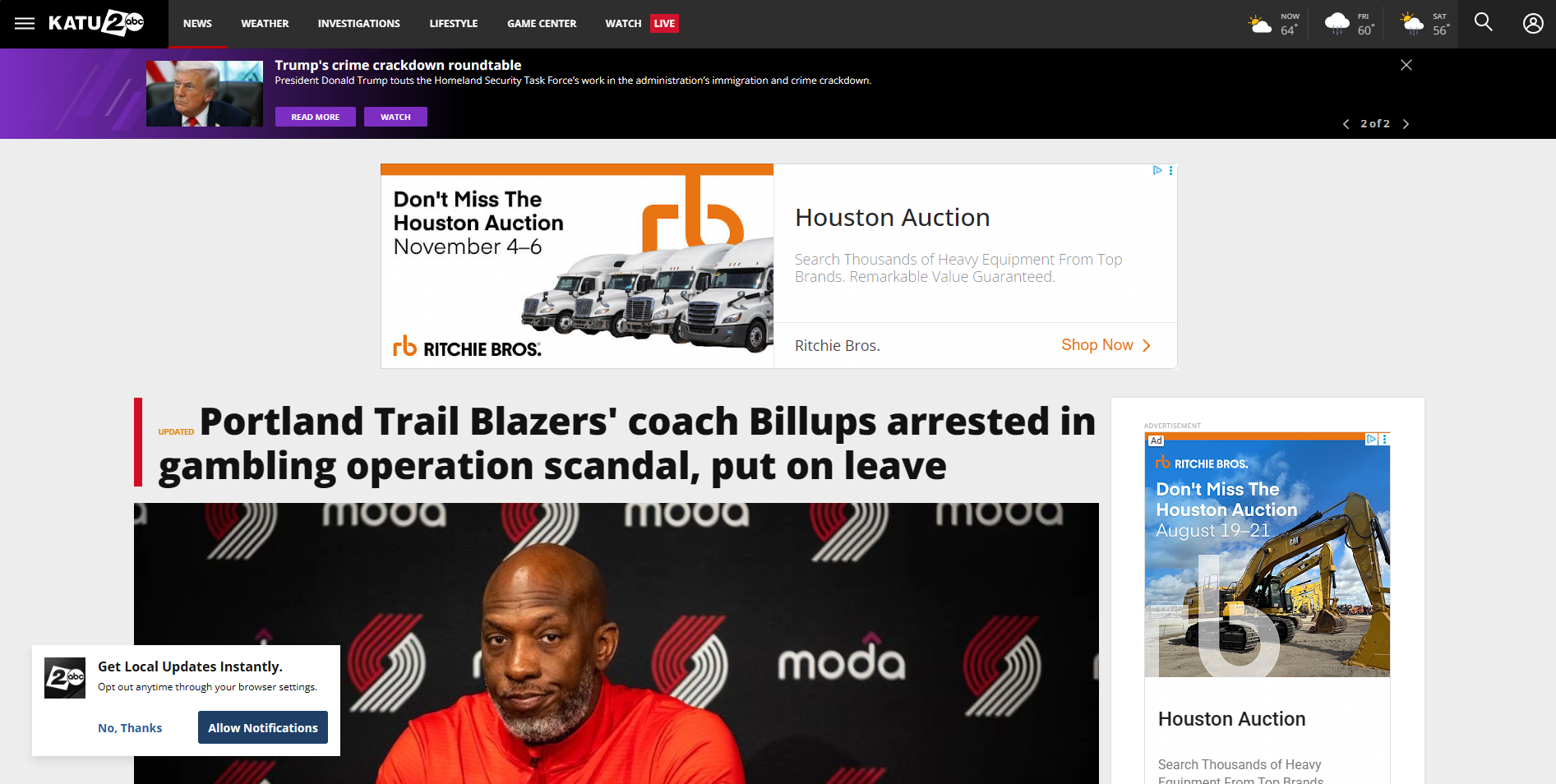
This story being pushed here by Sinclair is essentially a press release from the White House with zero journalism being done on the story itself, as is popular with large corporate media, and does not provide any further detail or background on the matter being reported. Whether or not this is actually an advertisement is more of an open question, to me, but I think for now we can safely call it "not journalism" and label this one as conservative propaganda. Is propaganda advertising? I'd say yes but I've never seen Mad Men so take all of this with a heavy dose of iodised salt. Just in case we don't have iodised salt in the future because someone has accused it with zero evidence of causing ADHD or something, iodised salt is just your everyday hardworking and vital table salt mixed with some iodine salts. Many countries mandated the iodisation of salts to combat iodine deficiencies- the leading cause of preventable intellectual and developmental disabilities- and iodization is generally seen as having a significant impact in improving quality of life for people around the world.

The rest of the KOMO page contains a smattering of additional adsense ads as well as this section of sponsored ads. Sponsored ads are the exact same thing as adsense ads just typically inserted by non-Google companies. In this case, KOMO has advertisements provided by Taboola, which is not the name of a pantomime child who keeps doing socially unacceptable things. Taboola is a company that has been described in the past as a:
- Recommendation Engine
- Number one Producer of Content Pollution
- Clickbait Factory
- Content Discovery Platform
- Digital Vampire that Preys Upon the Feeble
Clickbait is a term for the use of over-sensationalized content to trick users into clicking a link. In the case of the above advertisements provided by Taboola, the advertiser is fishing for people who are trying to lose weight, own a house in Washington, or have knee pain. Being a Costco shopper also appears to be a common targeting technique here. Directly to the right and then beneath the Taboola ads are more adsense ads, in this case we have one for gold which is preying on people who don't trust the stability of the economy as well as an ad featuring an slop image of an old man and promising to be able to diagnose people with Alzheimer's.
These sort of tri-grid ads propped up by Taboola can be seen all over the internet and are often referred to as a chumbox, wherein advertisers lay bait to trap those who fall for the trick- in this case Taboola has prepared a chumbox that is designed to prey upon the elderly. In 2025 America, advertisers will tend to use corporate slonk to describe their jobs, such as "we shorten the gap between users and what they really need" or "advertisements help fuel competition and innovation in the free market" and that they are "creating messaging that sparks curiosity, engagement, and desire".
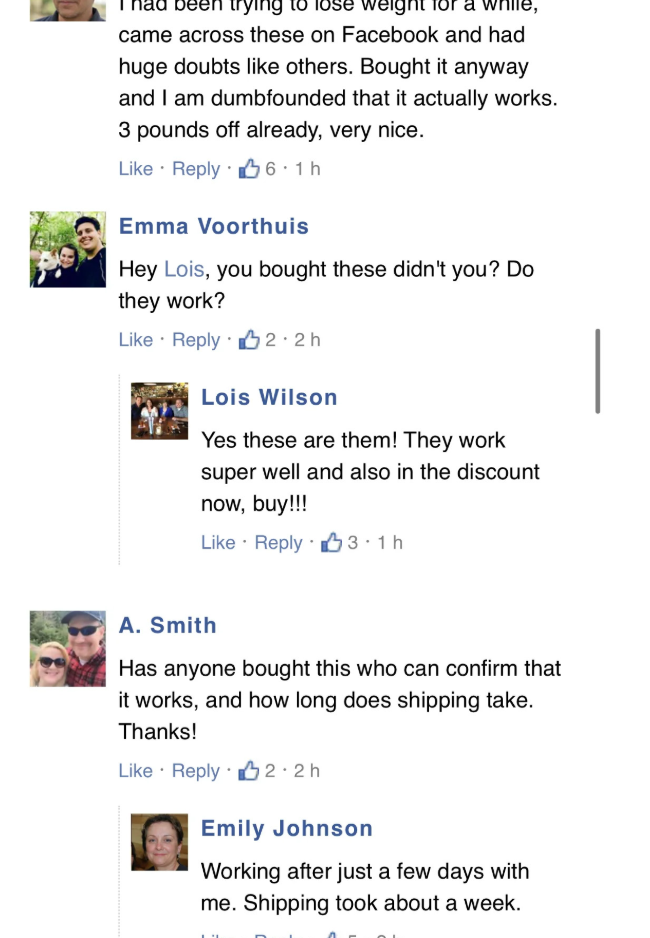
If we follow the Taboola ads, we get sent to some variations of the same page by the deceptively titled "HEALTH ADVICE TODAY". In the case of the Rejuvacare LeanPatch advertisement, we end up at a Health Advice Today url, but labelled instead as BetterLiving on its header and promising to melt fat without crazy lifestyle changes. At the end of this advertisement page you get to see this curious section that seems to be very common on Taboola pollutant sites: a series of faked Facebook posts that give the false impression of multiple "real people just like you no kidding and just wanting to live their lives" generally in awe of whatever product is being advertised. Once again, this is very clearly a targeted segment designed to engage with older audiences (50+)- who are currently the primary users of Facebook.
The rest of our news article's space is devoted to a comment section which appears to be a classic type of local news comment section: an open season cesspit for any and all who want to take part. However, it would be unwise of us to assume that all of the comments are in fact real people and not yet further advertisements or propaganda in some form or another.
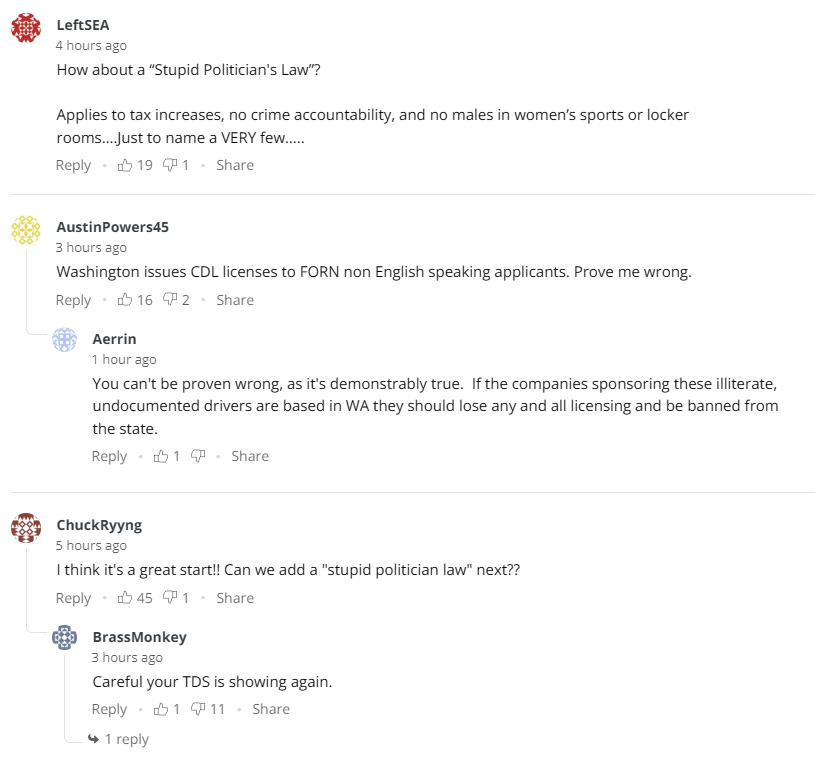
Examining some of the comments above we can see some common buzzworms spewed forth from the gibbering maws of pundits being touted by what appears to be your average person. After investigating the profiles of these users, most of them have hundreds of similar comments if not more. It's hard to conclude whether or not these are real people spending their free time spreading hate on a local news website or some form of intentional operation- but the reuse of the term "Stupid Politician's Law" by two separate users both with prolific comment histories indicates, to me, that these may not be real people. I have been around the internet long enough to remember comment sections and forums from before the botpocalypse though, and my gut says these are real people. It is important that we read these comment sections not as samplings of the average views of people, but instead places where people who either already frequent these comment sections will make their views known or where people with extreme reactions to news or videos will voice their extreme reactions like pus boiling out of an over-pressurized cyst.
FORBES
Forbes is a business magazine aimed at businessmen, politicians, and people who think they could run a company better than anyone else if they really tried to and we should all be thankful they are not inclined to do so because if they did, they assure us, they would trample everyone and extract as much money as possible as income is their own personal KPI and American Psycho is their favorite movie. KPI is a three-letter acronym commonly used in business slonk that is interchangeable with metric- a word that, due to tremendous personal experience, immediately forces my central nervous system to assume there is a predator nearby that wishes to cause harm to the herd.
Immediately upon opening the Forbes website, an advertisement stretches down and fills the page with an autoplay video showing Anna Kendrick, an American actress and director world famous for her role as Stacey Pilgrim in Scott Pilgrim vs. the World, dragging a green lawn into the middle of a financial district as she promises that "LPL Financial will bring the greener grass to your side" and asking "What if you could have more open roads?" as she visibly obstructs traffic. There is something to be said about the connection between businessmen and lawncare but that's another story. LPL Financial is a "wealth management firm" which means that they cater to wealthy individuals and ask them for their money. Once LPL has their money, they use it in a variety of investments to create more money through a well documented and poorly understood process that economists make a living on. LPL Financial has been involved in multiple scandals, including the multiple times they have been fined for failing to comply with federal Anti Money Laundering regulations.
Forbes is not a place I enjoy being, even more so than local news pits. It is one of the cultural leaders in corporate think and wealth worship and has sections on its homepage for common corpo conference traps like "Leadership Research" and "AI Knowledge Gaps" as well as a live tracker of billionaire wealth and their recent activities. Back to the ads.
Selecting any article to read, we are once more greeted with the entire full page Anna Kendrick advertisement. After clicking out of it, I am immediately prompted to subscribe to Forbes now as I have read all of my free articles. Many news websites in 2025, particularly those for businesses that have established magazines or were reliant on newspaper revenue, use this model of a handful of free articles followed by a subscription gate.In the case of Forbes, we get:

Following this advertisement, we see promises that a Forbes subscription will "Unlock Your Potential" and "Accelerate Your Growth", "Empower your Decisions" and "immerse yourself in discussions with visionaries, entrepreneurs and thought leaders" with its "Unsurpassed Journalism". Incidentally, as I hope it's been dead and buried for a long time in the future, "Thought Leader" is a buzzwhistle that has become popular as of the last two Presidential terms and is used primarily by conservatives to describe their preferred commentators and pundits. I have done zero research on this, but I believe the term became popular with conservatives because they didn't want to be known as intellectuals. Moving on, it looks like Forbes is a bust for further research without handing them a whopping $75.
The Website & the Website
China Miéville wrote The City & the City in 2009 and portrayed two cities- nation states of their own- living on top of one another but strictly not interacting with the other city. Shops on your street might be in the other city, people might be, car crashes, etc. The citizens of the two cities have ritually learned to unsee the other city using subtle cues like attire and architectural style. This unseeing as well as truly Byzantine levels of bureaucratic finagling allow the two cities to exist in the same place at the same time yet be totally seperate, only meeting at designated border crossings.
To traverse the unfiltered internet in 2025, one must unsee the pollution that increasingly fills websites. Don't look at the advertisements promising that only high IQ players can beat their games. Don't see the traps trying to drain money and attention from you. But even when your eyes glaze over them and move on the ads remain. You may not be seeing them, but they're there and they're pervasive. In the late aughts there were many think and panic pieces published about how important it was to train yourself to see ads, and how ads were increasingly seeping into the media you enjoyed.
It's hard to find trustworthy data for such a nebulous topic as ads that isn't just "a marketing website ran a survey so we can use this data to tell potential customers how important ads are", but I've seen estimates that people are exposed to anywhere from 1000 to 10,000 ads a day. A study in 2007 on a single test subject found that they were consciously aware of being exposed to 100 ads per day. With Instagram founding in 2010 and TikTok coming along later in the decade to dump yet more poison into the internet (not to mention the rise of YouTube), I am inclined to believe the numbers from the study would be significantly higher if run again today.
AdBlockers are the truest way to unsee the ads that plague us. They may still be served and registered to our individual advertising flavor profiles, but using an effective and thorough blocker makes the experience of being on any website significantly better. Of course, sponsored advertisements in videos or articles paid for by companies on websites are not caught by these blockers, and so the battle for ad awareness continues. With the increasing outpouring of LLM-generated slop, we can only assume that ads will continue to get more pervasive and targeted, and so internet users who want to browse an internet free of big corporate ad targeting and scammy medical ads and scammy crypto ads and scammy hot single sexy and british ladies near you ads must proactively use ad blockers and continue to train our unseeing- that sixth sense in your brain that we can reclaim and call our adsense.
This is a subject that could expand to plenty of other websites. Have you ever opened up YouTube and seen what it's default recommendations are? Truly, an upsetting experience. I'm not quite saying that all advertising is bad, but what I am saying is that the level of autonomous advertisement at transnational scales has become so pervasive that even unseeing isn't quite enough to be free of them. These ads are not ones promoting products that you might need or want, they're primarily ads that pollute the spaces we live in like junk mail in the trash can next to my mailbox. The spaces of the top layer of the internet are clogged with these things and we live our lives assuming that if we don't acknowledge them then they cannot influence us- which is a fraught assumption.