Carving the Ridge
Posted on: 19 March 2026
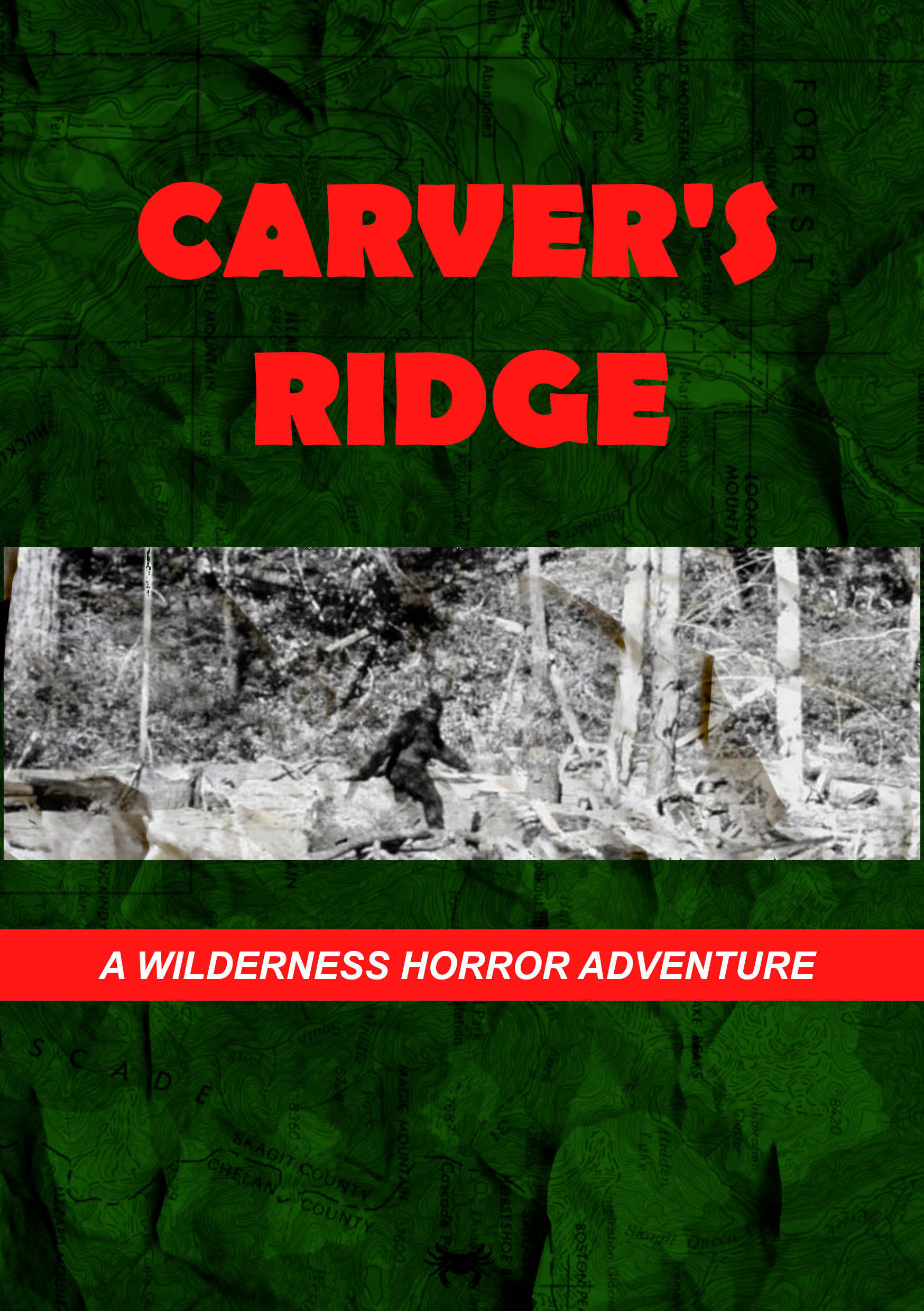
You Are Now Entering...
As December rolled around last year, I found myself with a bit more free time on my hands than usual and was working on writing for Second Wave when I was possessed by the idea of making my very own "high quality" adventure in the woods. Over the course of ~4 days I wrote the whole thing, learned how to do some basic image editing in GIMP, laid it all out, and published it on Itch, and now that a few months have passed I want to reflect on the whole thing and talk about how I put it together- and the mistakes made along the way.
The real spark for Carver's Ridge was the podcast episdoe The Wander, by Jeffrey Walker of Acephale fame. It's a wonderful tale about the wild places, what walks through them, and why we journey- and reflecting on it eventually crystallized into the idea of writing a bunch of weird horror encounters in the woods.
Writing for Other Freaks
Freaks is, of course, a double-edged but warmly bestowed compliment.
At the same time I was consumed by the motivation to write Carver's Ridge, I was swirling a few ideas around the old brain pan regarding TTRPG modules and adventures. Look, I've got a ton of these things. I don't even know how many TTRPG products I've bought (much less read), but one thing that became clear to me after some reflection was that some of them were more fun to read than others. Sure, some of this is due to prose and quality of construction, but there's also a certain degree of mystery that you feel a tangible pay off for when it gets revealed further in an adventure- or better yet when it's left ambiguous and flung at the game master to decide. These are the kinds of modules I like, ones that are written with some degree of narrative sequence and layering that rewards the person reading it- even if they will never run it. And honestly, I've run maybe one one-hundredth of the RPG products I've bought- and that's fine! Preferable even! I like reading these things to see what little ideas and details I can throw into the vat and eventually have resurface as something I want to use at my own table.
I can point out a few examples I really enjoyed of this quality of writing in others.
- Gradient Descent: An entire wonderful sci-fi megadungeon that puts the biggest challenge, the AI Core at the heart of the dungeon, at the very end of the module. Through the whole thing you're hearing about it, it affects every single floor panel and oozing android- but its lair and scope are reserved until 56 pages in. Really, this sort of pacing is very common, and one that Tuesday Knight Games uses often (Dead Planet, A Pound of Flesh [my beloved], Bug Hunt). This is more of the natural consequence of dungeon design- the biggest threat in the lair is put at the end of the book because it takes the longest to get to.
- Deep Carbon Observatory Remastered: Among the huge amount of facets of this adventure that could be pointed to, my personal favorite bit of narrative foreshadowing was the children's song referenced 13 pages in that then is continuously hinted and lampshaded. The song itself concerns a curse and a witch, who was thrown in a well and may be the source of many of the strange goings on arround the river valley. Only at page 47 is the witch introduced, explaining some simple facts of her nature and abilities and then further connecting to another location and character on page 87. This stretches the intrigue and mystery across the entire narrative experience of reading the module and I loved it.
- Ultraviolet Grasslands and the Black City: This tantalizing acid stained worldscape and adventure framework is all about journeying from your starting point in the Violet City to the Black City at the end of the world. The first 119 pages of this adventure is spent lavishly detailing locations encountered along the way to the Black City, but never really addressing what it is or why people are caravaning there- all the way until page 120 where we get the full picture of the city itself which fills in more of the general picture of the world at large.
Of course, these are game books and they're meant to be actually used at tables- so readability and clarity are certainly important factors. But for me, equally important is how interesting it is to read. You don't even need to commit fully to the "I'm going to read it from the first to the last page" style, but can still flip back and forth between certain sections and get huge pay off for this sort of narrative pacing. I'm not even sure if narrative pacing is the right term- but by reading an RPG module of any sort the author is necessarily communicating to you in some order- so whether intended or not the experience of engaging with this media is such that it creates a narrative.
These ideas are still gestating in my head and are definitely in need of refinement, but one of my goals going into making Carver's Ridge was to try and instill in readers a sense of mystery and the implication of a wider world- and to leave many of these answers and corners unpainted with just hints for the reader to then finish the drawing as they see fit.
On the Ridge
Up front- I made this entire thing in the wrong order and would absolutely do this differently the next time and I want to talk about why! I wanted to make something more professional in appearance and commit to a pdf format that was intentionally laid out and designed- an evolution from my previous two adventures. Now, the way that I understand reasonable people do this is that they first write out their content in one document and then layout that content, add images, do their formatting, etc in a second document that will be their final product. I did not do this.
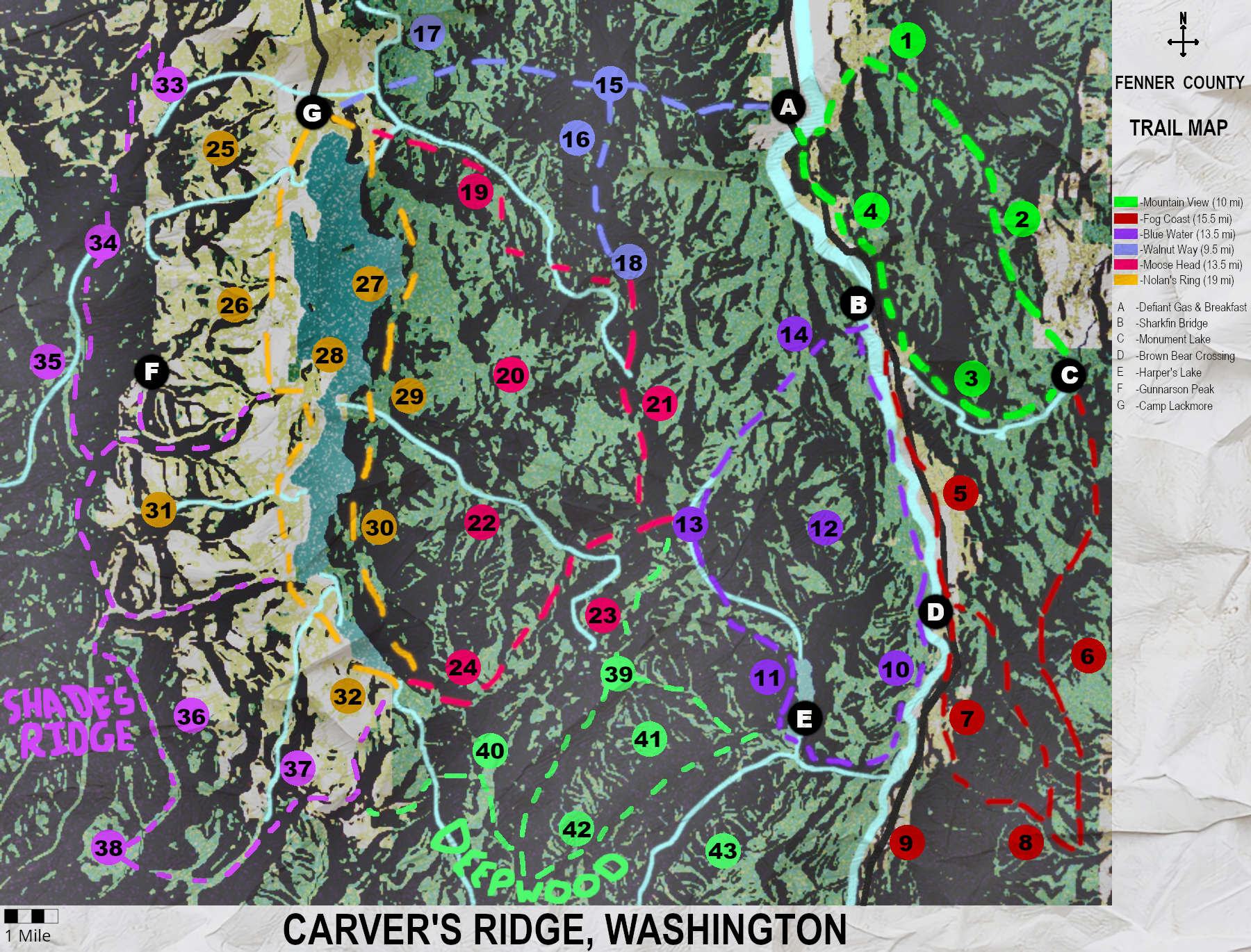
The first thing I did was make the map. Using a public domain US Forestry map originally published in 1958 as well as some public domain Forestry terrain maps as my basis, I first selected a portion of the map and got to work scrubbing it of names and redrawing in rivers and creeks more distinctly (the base map is a flipped map of Colville National Forest, WA).
Next I went about the introduction segment. I wanted to include a few backgorunds-as-hooks to invest players in the region, hint at locations and mysteries in the Ridge, and I think I hit that goal. Where I struggled and waffled was the system blah- I hate writing system blah and should have early committed to making Carver's Ridge a full Liminal Horror compatible project, but I also had the strong pull to ignore system entirely. Ultimately I ended up walking that clothesline, leaning in one direction or another, and should have committed fully. With the full thing in my hands, I think it would be best run with Liminal Horror- and maybe I'll do an edit to make it fully compatible some day.
Now, through this process of writing- I need to emphasize how bad of an idea my process was. First, I did all of the writing and layout in the same document, which was just a google doc. The whole thing is a google doc, and I did the layout as I was writing, imposing some unnecessary constraints (english professors have imposed the horrible curse of loathing 'tombstones' in pages) and forcing some strange pacing choices throughout. On the other hand, this also meant I was discovering the details of Carver's Ridge as I was writing it. Going in, I really had a vague shape of the whole thing, which I think colors the trails well- becoming more defined in their nature as you read from the starting point at the gas station and proceed further into the woods.
The Trails themselves are the meat of the whole experience and were the most fun to write. There's a lot going on with them, and I seeded a few points of interest early that would get some explanations here and there but never quite fully. I didn't want to explain why anything was happening the way it was in the Ridge, because I don't think that explanation is interesting- what's more interesting is the experience of being in the woods and the effects of the nature of the woods being what it is. Could I have spent some time specifically saying 'the giant bat monster is an experiment that escaped from the factory/the fort ruins which are both the way they are because of xyz'? Sure, but I think it's more interesting for the reader to come up with reasons if they need them. That sort of need to explain why things are the way they are is a hallmark of bad horror- at least to my tastes.
Doing all the layout as I was writing was exhausting and an awful idea in general, I would highly recommend no one else do that. The other big regret I have for the module is failing to get together an interesting idea for Henley Manor. Henley Manor is a rotting gothic mansion along one of the hidden trails in the Ridge, and some creatures (wax coffins) are implied to have come from it. I went back and forth on a few different concepts for it, like the manor belonging to someone involved with Fort Barker in the past, or it being the lair of some antiquarian consumed by one of their creations, but nothing solid would materialize and, frankly, I completely ran out of juice by the time I got to it. Ultimately, the best I had for it was that the wax coffins and its paintings were somehow related to the Nightflower garden on the same trail and fully left every other detail to the reader. Even with some months between writing the adventure and now, I'm still struggling to think of a good way to present the manor for play.
On the other hand, there were some places I'm quite proud of- like the Factory, and pretty much all of the Trails. Not every location on the Trails is immediately interesting, but I did strive to try and make them places you can do things- and interesting junctures to create emergent stories in conjunction with the encounter tables.
All in all, I don't think I met my goal of making reading this adventure an interesting narrative experience- at least I don't think I captured the feeling I've been trying to describe- but it's helped me better find the shape of that feeling for the next one. It was fun to make and to learn how to do some of the fiddlier bits of layout and image editing (the maps came out exactly how I imagined them) and if any of this sounds interesting- check it out for yourself!